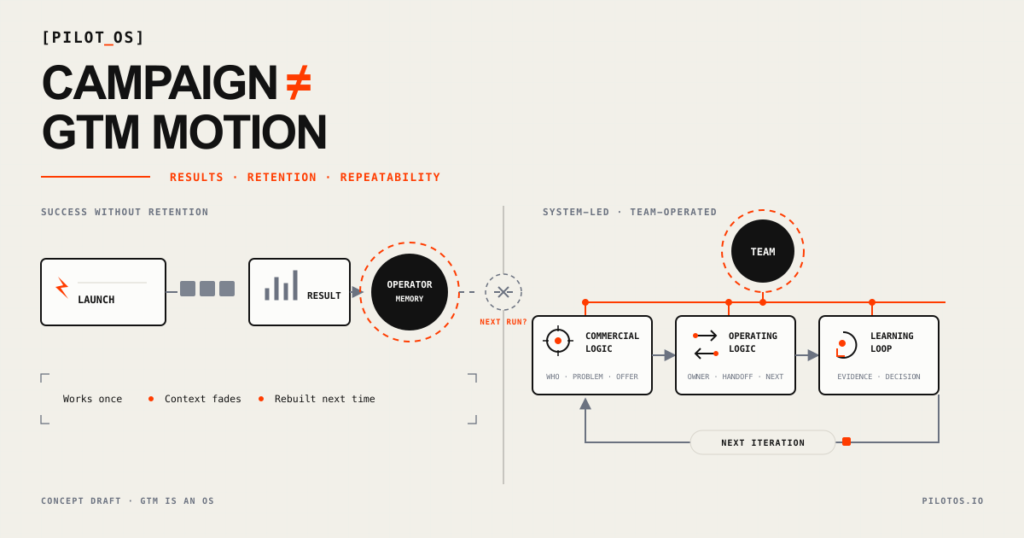
I’ve seen the same pattern with webinars, outbound, paid campaigns and content.
A campaign performs well. It attracts the right people, creates useful conversations and may even generate pipeline. Everyone is pleased with the result, and someone makes the obvious suggestion:
“We should do this again.”
Then the team gets together a few months later and realizes how much of the original thinking has disappeared.
Who exactly were we targeting? Which part of the offer got people interested? Who followed up with whom? What made a lead worth pursuing? Did sales convert the interest we generated? What would we deliberately keep or change next time?
In many companies, the next campaign starts with a reconstruction project.
That is why the distinction between a campaign and a GTM Motion matters.
A campaign can work.
A Motion means the company has learned how to make it work again.
Successful execution is not the same as repeatability
There is nothing wrong with campaigns.
You need them to test ideas, launch offers, enter markets, create demand and learn what buyers respond to. Some of the best GTM learning comes from running something before every question has been answered.
The mistake is treating a successful campaign as evidence that the company has built a repeatable growth engine.
Take a webinar as an illustrative example. You find a strong topic, promote it to the right audience and attract 60 registrations. Twenty people attend live. Sales gets three credible conversations from it.
Good campaign.
Now ask the team six months later why it worked.
Was it the topic, the speaker, the audience, the distribution or the timing? Was the follow-up unusually good? Did the attendees fit the ICP better than usual? Did the webinar create new intent, or did several already-interested accounts happen to attend?
If nobody can answer those questions with confidence, the campaign may have produced a result without producing much organizational learning.
The person who ran it may remember what worked. The demand generation lead may know which audience performed best. The founder may remember why the offer resonated. Sales may know which attendees were actually useful.
But the company itself has not necessarily learned anything.
The real value of repeated GTM activity is not that another campaign can be launched. It is that each iteration should leave the company better able to run, evaluate and improve the next one.
Otherwise, the capability remains dependent on individual memory, effort and instinct.
A campaign is an execution. A Motion is an operating capability
A GTM Motion is not simply a campaign that runs more often.
It is a repeatable way of creating and progressing demand where enough of the commercial and operating logic is visible for the team to run it, inspect it and improve it.
At minimum, a Motion makes five things clear:
- Trigger: What starts the Motion, and for which buyer or account condition?
- Steps: What should happen from first activity through commercial follow-up?
- Owner: Who owns the result across the handoffs, not merely one task?
- Metric: What evidence shows whether the Motion is creating and progressing demand?
- Review: When will the team decide to repeat, change, scale or stop?
This does not require a 40-page playbook. It requires the thinking that matters to survive the campaign.
The commercial logic has to survive
The team should know who the Motion is for, what problem or opportunity it is built around and what offer it is taking to that market.
This sounds obvious, but campaigns drift easily.
One quarter, outbound targets mid-market SaaS CFOs around a specific problem. The next quarter, the list expands, the message changes and three segments are added because the pipeline target increased.
Technically, the company is still “doing outbound.” In practice, it may now be testing several GTM hypotheses at once.
Activity continues, but the evidence becomes difficult to interpret. A higher reply rate might reflect a different segment. More meetings might come from a weaker qualification threshold. A lower conversion rate could come from the offer, the list or the handoff. The team cannot improve the system because too many parts changed at the same time.
A Motion does not require the audience and offer to remain fixed forever. It requires changes to be explicit enough that the team knows what it is learning.
The operating logic has to cross functions
The next question is what happens when somebody responds.
Who owns the Motion as a whole? When should sales get involved? What information needs to move with the account? What does qualified mean in this context? Which decisions can the team make without escalating everything to a founder or senior leader?
This is where seemingly successful campaigns often break.
Marketing generates the response it was asked to generate, but sales receives little context. A webinar attendee enters the same nurture sequence as everyone else. An outbound reply becomes a meeting, but nobody records which message or buyer problem created the interest. Each function completes its task, while the commercial system around the campaign remains weak.
GitLab’s public marketing handbook offers a useful operating example. It explicitly describes a GTM Motion as something that can contain one or more campaigns, supported by a GTM strategy, sales plays, enablement and reporting. Its sales-play guidance includes the offer, who to meet, what to say, what to show and how to measure progress. The point is not that every company needs GitLab’s level of documentation. It is that the campaign sits inside a larger cross-functional system rather than being mistaken for the system itself.
For details, see GitLab’s documented GTM Motion structure
Research on sales and marketing alignment points in the same direction. In a global LinkedIn study of more than 3,500 sales professionals and 3,500 marketers, respondents most often associated stronger collaboration with shared objectives and KPIs, better customer insight, clear accountability and workflow, and regular meetings. The findings are descriptive rather than proof that those practices cause repeatability. They do reinforce that enthusiasm alone does not create a working handoff. The operating conditions have to be designed.
Read: LinkedIn’s sales and marketing alignment research
The learning loop has to produce a decision
Someone has to look at what happened and decide what the evidence means.
Not only whether impressions increased or whether the campaign hit its lead target.
Did the right people respond? Where did good opportunities come from? Which part of the Motion appears constrained? Did engagement become pipeline? Did pipeline progress? What should change next time, and what should remain stable so the team can learn properly?
This is where measurement and operating Rhythm matter.
A dashboard does not create learning by itself. A weekly or monthly meeting does not either. Learning occurs when shared evidence leads to an explicit decision.
Without that decision, the next iteration tends to inherit a mixture of preferences, memories and untested explanations. The team changes several things, gets a different result and still cannot say what it learned.
The Motion Readiness Test
The easiest way to tell whether a campaign is becoming a real Motion is to ask:
- Can the team clearly explain who this is for, what triggers the Motion and why the buyer should care?
- Does someone own the Motion as a whole rather than one task inside it?
- When the Motion creates interest, does everyone understand what should happen next?
- Can the team see enough of the commercial journey to know whether activity is progressing toward revenue?
- After each iteration, does the team make an explicit decision to repeat, change, scale or stop?
Then ask the most revealing question:
If the person who ran the last campaign disappeared tomorrow, could another competent person run the next iteration without rebuilding the thinking from scratch?
If the answer is no, you may have a good campaign. Much of the capability still lives with the operator.
That does not mean the campaign failed. It means the company should be honest about what has and has not become repeatable.
More channels do not solve a missing system
Companies often respond to inconsistent pipeline by adding another campaign, channel or hire.
They add outbound to paid, partnerships to content, or events to account-based marketing. Every initiative brings its own audience assumptions, workflows, handoffs, reporting and ownership questions.
If the operating infrastructure is weak, more channels create coordination cost before they create reliable pipeline.
The company ends up running several campaigns but owns very few Motions that it genuinely knows how to operate.
This is why “Which channel should we add?” is often the wrong first question. A better question is whether the company can explain and repeat what already appears to work.
Not everything needs to become a Motion
Some campaigns should remain campaigns.
A product launch may be temporary. A conference may matter this year and not next year. A market event may create a short window worth exploiting. A partnership opportunity might be genuinely unique.
Trying to systemize every piece of GTM would create bureaucracy quickly.
The question is whether you expect this route to market to contribute repeatedly to growth. If you do, the standard has to become higher than “the last campaign went well.”
You need enough visibility into the surrounding system to know why it worked, what depended on individual judgment and what needs to become repeatable.
Repeatable does not mean rigid. A healthy Motion should evolve. The audience may narrow. The offer may change. The handoff may need work. A channel may look promising for three months and then stop performing.
The goal is not to freeze the Motion. It is to make sure the learning survives each iteration.
What to do after a campaign works
When a campaign produces encouraging results, add one step before the context disappears.
Bring the people involved together and capture what you believe happened:
- Who responded, and why?
- What created the strongest commercial signal?
- Where did the process work smoothly?
- Where did people have to improvise?
- Which decisions required senior judgment?
- What did sales learn that marketing should know before the next iteration?
- What should remain unchanged for the next run?
- What evidence would justify scaling, changing or stopping the Motion?
Turn the answers into a lightweight playbook with the trigger, steps, owner, metric and next review date. Assign any instrumentation or handoff fixes before the next run begins.
That conversation does not need to become a complicated process. Its job is to convert a temporary result into operating knowledge.
Do that repeatedly, and the company stops merely getting better at launching campaigns. It begins building commercial capabilities that survive individual campaigns, individual operators and eventually individual founders.
That is when GTM begins to behave like a system.
If the Motion Readiness Test exposes unclear ownership, weak handoffs or untrusted measurement across several initiatives, the PilotOS GTM Scorecard can identify the binding constraint and turn it into a focused 30-day operating plan.