Founder involvement is often one of the strongest commercial advantages an early company has. The founder understands the problem deeply, carries conviction into the market, hears weak signals before anyone else and can make connections across product, customers and revenue that a new hire will miss.
So the goal is not to get the founder out of go-to-market.
The goal is to stop the entire go-to-market system from depending on the founder to function.
That distinction matters because many teams diagnose the problem incorrectly. They see the founder joining sales calls, shaping content or maintaining key relationships and conclude that the company has failed to mature. Then they respond by hiring people, adding tools or forcing the founder to step back.
But founder visibility is not evidence of founder dependency.
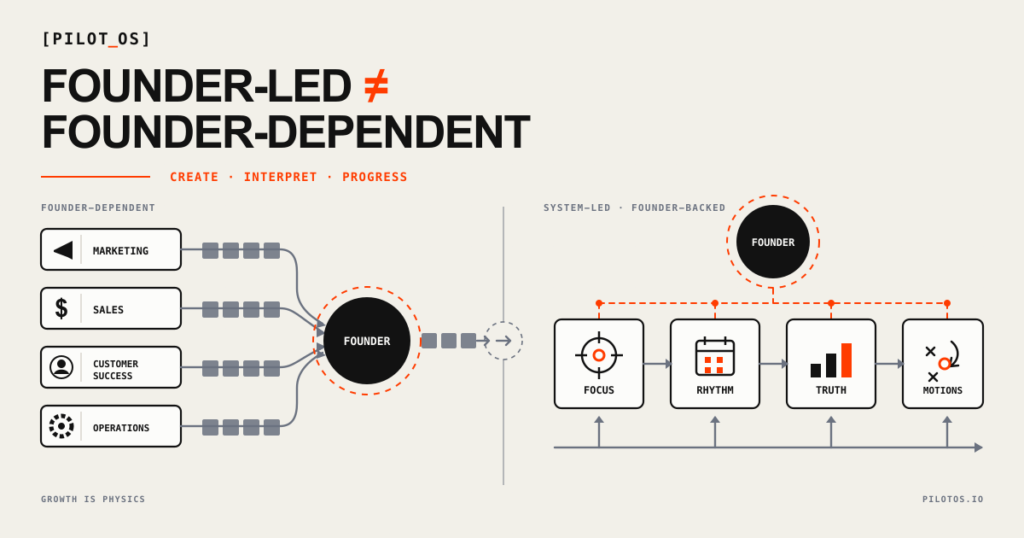
The real test is whether the company can reliably create, interpret and progress commercial work without the founder personally carrying the logic behind it. If the answer is no, the company does not simply have a delegation problem. It has an operating-system problem.
Recall.ai offers a useful example of the distinction. Co-founder and COO Amanda Zhu personally closed more than $7 million in enterprise deals while learning how customers bought, where deals stalled and which objections mattered. According to Bessemer Venture Partners, she converted what she learned across hundreds of calls into a clearer discovery structure, qualification logic and sales playbook. The sales organization she helped build went on to drive 4x year-over-year growth. The important part of the story is not that the founder stopped selling. It is that her judgment became visible enough for an independently led team to use.
Founder-led and founder-dependent are different operating states
In a founder-led company, the founder remains deliberately involved where founder judgment creates unusual value. That may include positioning, pricing, major partnerships, strategic accounts, product direction and senior hiring. The team can still run the normal commercial system because priorities, definitions, ownership and decision rules are visible.
In a founder-dependent company, the founder is not just contributing judgment. The founder is acting as the integration layer for the whole system.
Marketing needs the founder to decide which message is credible. Sales needs the founder to interpret whether an opportunity is serious. Customer success needs the founder to distinguish a one-off request from a market signal. Operations needs the founder to reconcile what the CRM says with what is actually happening. Weekly meetings surface questions, but the questions wait for the founder to become decisions.
The company may have talented people, documented processes and expensive software. Work still slows down or loses quality when the founder is unavailable.
That is founder-dependent GTM.
How founder dependency develops
Founder dependency is rarely designed. It accumulates.
At the beginning, carrying the commercial system personally is rational. The founder speaks to customers, adjusts the offer, qualifies opportunities, closes deals and decides what to build. Information moves quickly because one person holds most of it. There are few handoffs and little need to formalize the reasoning behind decisions.
This is also consistent with how experienced cloud investors describe the stage. In its guide to scaling from $1 million to $10 million ARR, Bessemer characterizes the journey as a transition from founder-led selling toward a scalable, sales-led process. At the beginning of that range, founder participation in important sales meetings is expected because the founder carries product knowledge, vision and authority that a new representative does not yet have. The constraint appears when that advantage remains trapped in one person as the volume of commercial work grows.
Then the company grows.
Marketing, sales, customer success, product and operations begin to see different parts of the market. New people inherit tasks, but they do not automatically inherit the founder’s commercial judgment. The ICP may exist in a document, yet the founder still knows which apparent fits to reject. The sales stages may exist in the CRM, yet only the founder knows whether a deal has real momentum. The content calendar may be assigned to marketing, yet the useful ideas still depend on what the founder remembers to share.
This creates a dependency loop:
- Commercial judgment remains concentrated in the founder.
- Teams make decisions with partial context or escalate uncertainty upward.
- The founder intervenes to protect quality, speed or revenue.
- The immediate problem gets solved.
- The system never learns how the founder reached the decision.
The rescue feels productive because it often works. It also preserves the condition that made the rescue necessary.
As volume and headcount increase, this loop becomes expensive. More activity creates more exceptions. More exceptions create more questions. More questions pull the founder deeper into normal execution. The founder becomes busier while the company becomes no more independent.
The symptom changes depending on where the dependency sits
Founder dependency does not always look like a founder closing every deal. It can sit inside any part of GTM.
It may be a Focus problem. The company has several plausible customer segments, offers and channels, but the actual priority changes whenever the founder has a new conversation. People stay busy because the stop list is unclear.
It may be a Rhythm problem. Meetings collect updates, while cross-functional decisions remain unresolved until the founder weighs in. Ownership exists on paper but not at the point of decision.
It may be a Truth problem. Marketing, sales and finance use different definitions for qualified pipeline. The dashboard reports numbers, but the founder privately decides which numbers are believable.
It may be a Motions problem. Referrals, partnerships, outbound, content or sales work when the founder supplies the relationship, insight or final push. The activity cannot run as a repeatable trigger-to-owner-to-metric system without founder energy.
These failure modes produce different surface symptoms. Pipeline may look lumpy. A sales hire may appear weak. Marketing may look inconsistent. Forecast meetings may become arguments. The common response is to add tactics or replace people.
That response is premature until the dependency itself is located.
The Founder Dependency Test
The Founder Dependency Test is a working diagnostic for one question:
Can the company reliably create, interpret and progress commercial work without founder rescue?
This is not a test of whether the founder can disappear for a month. Nor is it a benchmark against other companies. It is a way to identify where normal commercial work still relies on knowledge, authority or intervention that has not transferred into the operating system.
For each area below, mark the current state:
- Green: the team can do this reliably using shared context, definitions and ownership.
- Amber: the team can do it, but the founder regularly validates, corrects or accelerates the work.
- Red: the work stalls, changes direction or loses material quality without the founder.
1. Can the team create commercial work?
Consider whether the team can:
- identify and reject accounts using a shared ICP gate
- turn buyer problems into credible offers, messages or conversations
- initiate a priority pipeline Motion without waiting for founder input
- create demand outside the founder’s personal network or presence
A red result does not mean the founder should stop contributing ideas or relationships. It means the company has not yet converted those contributions into something others can operate.
2. Can the team interpret commercial signals?
Consider whether the team can:
- distinguish activity from meaningful pipeline movement
- explain what each funnel or deal stage means in practice
- identify whether a weak month is a volume, conversion or consistency problem
- separate an important buyer signal from an isolated request
- agree which dashboard or evidence should drive a decision
If people can collect data but still need the founder to tell them what it means, Truth remains founder-held.
3. Can the team progress commercial work?
Consider whether the team can:
- qualify and advance ordinary opportunities without founder rescue
- make cross-functional GTM decisions with a named owner and deadline
- handle common objections using shared commercial judgment
- decide when to continue, change or kill an experiment
- maintain momentum when the founder is focused elsewhere
Founder involvement in a strategic deal does not create a red result by itself. The warning sign is when routine progress depends on the founder doing work the system was supposed to own.
The pattern matters more than a score. A cluster of amber and red answers usually identifies a specific concentration of knowledge, authority or decision logic. That is the constraint to fix first.
Transfer judgment, not just tasks
Delegation often fails because companies transfer activity while leaving judgment behind.
A founder can assign prospecting, content production or pipeline management to someone else. If the new owner cannot see how the founder identifies fit, interprets evidence or makes trade-offs, the work will either drift or return to the founder for approval.
The transfer therefore needs to make decision logic observable.
For Focus, this means a clear ICP gate with disqualifiers, an offer the team can explain, priority channels, targets and an explicit stop list.
Teleport followed this sequence before expanding its sales team. The company first forced clarity around four questions: what it sold, who the customer was, why customers bought and why they bought from Teleport. It added more representatives only after the earlier hires were reaching productivity targets. Founder judgment did not disappear. It became an explicit commercial model that other people could test and operate.
For Rhythm, it means a weekly decision cadence with owners, a decision log, an experiment backlog and kill rules. The meeting should resolve what happens next, not merely report what happened.
For Truth, it means shared stage and metric definitions, one trusted view of the funnel, and decision rules attached to the numbers. If definitions are contested, optimization should pause until the glossary is settled.
For Motions, it means documenting the trigger, steps, owner, service level, instrumentation, primary metric and next review date. A channel becomes a Motion only when it can run again without being reconstructed around the founder.
This is how a company moves from founder-dependent to system-led, founder-backed GTM. The founder still contributes the judgment that only the founder can provide. The rest of the company no longer waits for that judgment to perform normal work.
Do not remove the founder from the wrong work
There is a bad version of this transition: treating all founder involvement as a failure and forcing distance before the team is ready.
Some decisions should remain founder-led. Positioning changes, pricing, major strategic bets, pivotal relationships and senior talent choices often deserve direct founder attention. A founder may also be the company’s strongest public voice or most credible seller in complex deals.
The operating question is not, “How do we get the founder out?”
It is, “Where is founder judgment uniquely valuable, and where is the company relying on the founder because the system is incomplete?”
Those are different categories of work. Mixing them leads either to founder overload or premature delegation.
Hiring does not remove the dependency
It is tempting to treat a sales or marketing hire as the transfer mechanism. In practice, the hire inherits whatever operating system already exists, including its missing definitions, invisible judgment and weak handoffs.
The cost of discovering that slowly is significant. The Bridge Group’s 2026 survey of 158 B2B companies found that 48% of account executives were at quota, average ramp time had reached 6.2 months and median on-target earnings were $200,000. This research covers established account-executive motions, not specifically founder-stage companies, and the survey is observational. It does not prove the Founder Dependency Test. It does show why adding headcount is a slow and expensive way to discover that the commercial logic was never transferable.
A new hire may still be the right move. The decision rule is to ask whether that person is being hired to operate and improve a visible system, or to reverse-engineer one from the founder while carrying a revenue target. The second job is possible, but it is a very different role and should be hired, onboarded and measured accordingly.
A practical first move
Do not try to remove every dependency at once. Choose one recurring commercial outcome that still requires founder rescue.
Trace the work backward:
- What did the founder know that the team did not?
- Which definition or decision rule was missing?
- Who appeared to own the work, and who actually made the decision?
- What evidence should have allowed the team to proceed?
- What needs to be recorded, instrumented or reviewed before the next run?
Then change the system and test it on the next real cycle. The test is not whether the founder did nothing. The test is whether the team created, interpreted and progressed the work with the founder contributing only where founder judgment was intentionally required.
That is the shift worth making.
Founder-led GTM can remain an advantage for a long time. Founder-dependent GTM becomes a constraint when growth produces more commercial work than one person can create, interpret and progress. Hiring around that constraint does not remove it. Adding more activity usually exposes it faster.
The answer is not founder absence. It is an operating system that preserves founder judgment without making the company wait for it.
If the Founder Dependency Test surfaced several amber or red areas, the PilotOS GTM Scorecard is the next diagnostic step. It identifies the binding constraint and turns it into a focused 30-day operating plan.